Wednesday, August 11, 2010

Kashmir and Development Economics...on Facebook

Recently a couple of friends asked about my opinions on Kashmir. I am sadly not as informed on these issues as I should be and, after looking at the issues briefly, I only have some loosely collected thoughts on the issues. Let me at least start off with the questions raised by my friends.
Aha. But didn't you once use a Jain swastika as your avatar at Thom's? That's what made me think she was. Our babysitter is a Jain. Don and I are talking about Kashmir, and Don has taken a Jainist approach on a facebook thread about the issue. Your and Dina's opinions on the subject are welcome if you feel so inclined.

I read through the whole thread and not sure about the "Jainist approach" as Don practiced. The Swastika as I had used is a general Hindu sign as in the sign I used:
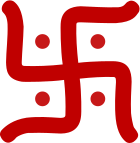
I see that Jainism post uses the same symbol but then Portal:Jainism uses:

And the link to Jainism is slightly less elaborate and more like the Nazi symbol at the bottom of Portal:Hinduism. Anyway, my wife says the one I used is a general Hinduism symbol.

I think the threads referred to are private conversations but the that started the research was at Germaine Taylor via Suhail Paradise Burning. And this got me involved in a discussion on a Kashmir thread at Videos Posted by Koshur Mazloom.

There certainly was a lot of information covered so let me just briefly state my observations so far through a couple of my posts:
1. I suppose the question that has not been addressed {at least on this thread} is what happens after India leaves Kashmir? Does anyone seriously think it will spontaneously form a new nation state and everyone will respect its territorial int...egrity? If you do, I have a bridge to sell you.

Too many outside interests have stakes in the outcome. And if it dos fall to Pakistan or China, what then? Do you think it will be better off or... Burma and Afghanistan should provide clues on those two outcomes.

2. Viability is not the issue. Strong states will do what it wants on weaker states. Since all three powers in the region have stated an interest in Kashmir then it is foolish to think that just because of independence that it suddenly becomes... an autonomous state.

So Amar Diwakar, I am sure you are right about the economic viability of Kashmir, but it takes more than that. Although I would be curious as to how the poverty levels compare in Kashmir with the averages in India and then in the poorest states.

As one of my friends would say, you may have no purpose in war, but war may find purpose in you. {Or something like that...}

3. On one of my forums, I am studying Development Economics and one passage that might be of interest here is this from:
Paul Collier, "On Economic Causes of Civil War" {Page 7}:
Between them, these four variables {Per Capita Income, Share of... Primary Exports in GDP,Ethno-Linguistic Fractionalisation, Economic Inequality (Gini)} make a huge difference to the chances of civil war. Consider two societies, one ideally endowed in terms of the four variables and the other catastrophically endowed. The ideal society would have the maximum income found in our sample ($9895), the maximum natural resource endowment (67%), the maximum inequality (0.69), and the maximum ethno-linguistic fractionalisation (93). It would have a risk of civil war of under 0.000001 percent. The catastrophic society would have the lowest income found in the sample ($316), a slightly above average endowment of natural resources (0.18), the lowest level of inequality (0.30), and a slightly above-average degree of ethno-linguistic fractionalisation (46). It would have a risk of civil war of 0.97.


Just a couple more links I want to add. The first was presented on the initial thread above at Huffington Post titled Arundhati Roy: What Have We Done to Democracy?. The second one was for a search on "azadi" at What ails Kashmir? The Sunni idea of ‘azadi’. I looked it up as people were throwing that term around in a forceful manner.

Some of the issues with Kashmir have been studied by Paul Collier. Might add some more of what he wrote on conflicts and developing nation states.

Labels:

Friday, March 28, 2008

Liberal Democracy and Fiscal Rules

Part of my paper on Fiscal Rules for the class Macroeconomic Policy and Financial Markets.
5. Liberal Democracy:
There seems to me to be some broader questions that I must raise in the context of the ideas and concepts we have learned in class. I first start with a “Key Point” from the book “Macroeconomics: Understanding the Wealth of Nations”.

“It may seem strange for governments to hand such an important policy instrument over to an unelected group of officials and ask them to target only inflation. However, our analysis shows that the fact the central bankers are unelected and do not have a policy goal of achieving low unemployment is crucial in achieving better outcome for society.” (Miles & Scott, Ch. 16, Page 428, Ref 2a)

While this passage directly talks about the monetary branch of government, it is conceivable that these same valid points could be used to justify Fiscal Rules as shown by Buiter in “Fiscal rules in a monetary union…” (Ref. 3, Page 2); The IMF in promoting coordination of Monetary and Fiscal Policies where if one arm is independent and it coordinates with the less independent then independence must be broken from the legislative/executive branches to at least some degree (Ref. 4); and lastly The HM Treasury paper on Fiscal Stabilization (Ref. 5).

So the question that arises for me is whether strict rules based application of monetary and then fiscal policies could undermine the Liberal Democracies (Ref. 11) that much of the world is based on including most of the developed countries. This unelected group of officials for better or worse have created and fostered an atmosphere of conspiracy about the Federal Reserve System being “owned by the banking system” from both the left and right on the political spectrum.

The IMF has learned that no matter how knowledgeable the staff is about the problems facing member states, that at some point more conditionalities only lead to less compliance rather than more. Buira poses two important questions:
1. “Can program ownership by a country be made compatible with externally imposed conditionality?”
2. “Is conditionality compatible with democracy?”
The East Asian Crisis marked the high mark of conditionality with Indonesia receiving 140. Since that time other policies have been implemented by the IMF including Poverty Reduction Strategy Papers where applying member countries must develop their own strategies for dealing with poverty and receive input from all parties (Ref. 9, page 57)

Kaipur and Naim also note the change in the IMF by emphasizing “ownership” in various lending facilities and tie in between good governance and development of democratic institutions that create good economic growth. They also make an important point in: “Of greatest concern, perhaps, is the inherent tension between conditions imposed by an outside lender and the cardinal democratic principle of consent. By their very nature, IMF conditions arise not from debate and discussion within a society, but come rather from unelected foreign experts.” (Ref. 10, page 91)

C225 Session One 2008
Assignment Two
by: Ronald Rutherford
References and Footnotes


References:
1. CeFiMS Course Book, Macroeconomic Policy & Financial Markets-C225, Product 4157
a.

2. Miles David and Andrew Scott (2005) Macroeconomics: Understanding the Wealth
of Nations, Second Edition New York: Wiley.
a. Chapter 16, Page 428


3. Willem Buiter (2003), ‘How to Reform the Stability and Growth Pact’, European Bank for Reconstruction and Development.

4. E Laurens & BG de la Piedra (1998) ‘Coordination Of Monetary & Fiscal Policies’, IMF Working Paper WP/98/25.

5. HM Treasury (2003), ‘Fiscal Stabilisation and EMU’.

6. Carl Emmerson, Chris Frayne and Sarah Love (2001, Updated 2006), “The government’s fiscal rules”, http://www.ifs.org.uk/bns/bn16.pdf

7. Public Sector Finances first release (monthly), 20th February 2008 (January Data), provided by Sharone Karagach in class discussions.

8. G Sterne, ‘The use of explicit targets for monetary policy: practical experiences
of 91 economies in the 1990s’. Bank of England Quarterly Bulletin, August 1999, Vol 39, No 3. http://www.bankofengland.co.uk/qb/qb990302.pdf

9. Ariel Buira, (2005) “Challenges to the World Bank and IMF”, Chapter 3, “An Analysis of IMF Conditionality”, Anthem Press

10. Devesh Kapur and Moisés Naím, (2005), “The IMF and Democratic Governance”, Journal of Democracy, Volume 16, Number 1.

11. Liberal democracy; http://en.wikipedia.org/wiki/Liberal_democracy

12. Fiscal policy in the UK: Index; http://www.hm-treasury.gov.uk/documents/uk_economy/fiscal_policy/ukecon_fisc_index.cfm

13. UK's Government should scrap fiscal rules - NIESR; http://www.forbes.com/afxnewslimited/feeds/afx/2008/01/31/afx4601307.html
http://www.lse.co.uk/politicsNews.asp?shareprice=&ArticleCode=kzrhp9jsj49iq1i&ArticleHeadline=UKs_Government_should_scrap_fiscal_rules__NIESR

14. UK's Darling stands by budget GDP forecast despite renewed market turmoil UPDATE, http://www.iii.co.uk/news/?type=afxnews&articleid=6612481&subject=economic&action=article


15. Robert Peston, Taxpayer's £100bn Rock exposure, http://www.bbc.co.uk/blogs/thereporters/robertpeston/2008/02/taxpayers_75bn_rock_exposure.html

16. U.K. government to nationalize Northern Rock, http://www.marketwatch.com/news/story/uk-government-nationalize-northern-rock/story.aspx?guid=%7BB54FB0C9%2DFD45%2D4796%2D9FB0%2DDD042DA18612%7D&siteid=bnb

17. UK govt at risk of breaching sustainable investment rule in 2010-2011 - IFS, http://www.iii.co.uk/news/?type=afxnews&articleid=6600822&subject=economic&action=article

18. Old Lady urged to loosen purse strings, http://www.guardian.co.uk/business/2008/mar/22/bankofenglandgovernor.economics

19. JOELLEN PERRY (January 28, 2008), “Bank of England Chief
Changes Tack in Crisis”, Wall Street Journal.

20. Speech by the Chief secretary to the Treasury, Paul Boateng MP, PFI Congress, (10 June 2003), http://www.hm-treasury.gov.uk/newsroom_and_speeches/speeches/chiefsecspeeches/speech_cst_100603.cfm

21. Future, http://en.wikiquote.org/wiki/Future

Labels:

Wednesday, May 30, 2007

U.S. ranks 96 in new peace index|Global Peace Index


I just wanted to get this information out to reference and to direct people to the links so far. I will hopefully update the information as I find more.

The ranks by country on the study is located at: VoH Rankings. Obviously this looks biased when the USA is 96th and Israel is 119 out of 121 countries ranked. Surprise, surprise, surprise Jimmy Carter is involved as well as Professor Joseph Stiglitz from Key Endorsers for the Global Peace Index.

Some of the factors that do not make sense to me as with respect to USA is:
Ease of access to weapons of minor destruction 3
So it is like you sin if you give the citizens freedoms. It would be like judging sins of Christians by how close they are to a bar.

Number of jailed population per 100,000 people 5
A large percentage due to "War on Drugs". Sorry it is not a "War". But does jailing people mean that you are more peaceful or less. They assume the more you incarcerate the less peaceful you are. Maybe we give more freedoms like the weapons issues but prosecute more.

Potential for terriorist acts 4
Punishing the innocent again. Potential is not the issue only how it is prosecuted.

UN Deployments 2006-07 (percentage of total forces) 5
Why rank low for trying to maintain "Peaceful" UN deployments around the world? Isolationists do better.

Military capability/sophistication 5
PLEEEEEEEEEEAAAAASE, we will all live in peace and harmony if we only had sticks and stones. I think Rwanda shows that this is a logical fallacy.

Estimated number of deaths from organised conflict (external) 3
Again, punished for outside sources beyond our control.

Well I do like these types of reports but in the end I am greatly disappointed by the obvious bias and non-logical thinking, even if you use statistical measures.

Links:
Global Peace Index

http://www.visionofhumanity.com/index.php

Welcome to the Alliance for Peacebuilding!

Global Peace Index Report-PDF

Labels:

Saturday, December 10, 2005

Mugabe: No crisis, UN envoy lying/Mugabe King of the Losers

President Robert Mugabe has accused the United Nations' most senior aid official of lying about the severity of Zimbabwe's humanitarian crisis and said many other African countries were worse off than his.

This is the most funny thing I think I have heard an African leader say. Yes, at least my country is not as bad as other despot ruled countries. But it is hard to beat this:
Zimbabwe police and recruits used bulldozers and sledgehammers to demolish shacks, homes, market stalls and small business in poor areas across the country during what was dubbed Operation Murambatsvina, or Drive Out Trash.

The operation that began in May and was declared over in July left more than 700,000 homeless or without livelihoods, or both, according to UN estimates, that the government has rejected as an exaggeration.

Now after destroying peasants homes what will he allow relief organizations to do to solve the problems he created:
During talks with Egeland, Mugabe refused a UN aid offer of tents to shelter the hundreds of thousands of victims of the urban demolition campaign, saying he would only accept assistance to build permanent housing.

Now what shall the UN do for the situation...
Egeland ended his mission to Harare and Bulawayo on Wednesday warning that "the humanitarian situation in Zimbabwe is very serious".

"The prospects are worrying. The need for international assistance is big and growing. The people of Zimbabwe are suffering under several big problems," he told a news conference in Johannesburg.

But unless the aide is channeled directly to the people in need through NGO's and not the Zimbabwe government we should not send relief. This is because in the end it will only hurt the people we want to help.

And I can never understand the opposition. If they think they are safe from this tyrant they are dreaming. If Mugabe is willing to destroy the houses of 700,000 people that opposed him, what else do you think he would do if given the chance. I personally would flee the country just as the boat people did.

Links of note:
How the Loss of Property Rights Caused Zimbabwe's Collapse

Above link went bad, probably GlobalisationInstitute changed their website so old links do not work now, but the following two links (2nd PDF) were what they were linking to:
How the Loss of Property Rights Caused Zimbabwe's Collapse by Craig Richardson

Report as PDF

Labels:

Friday, November 25, 2005

Different Political Spectrums


In the US ,or more broadly the world, the political spectrum is most often represented as a simplistic line as in Left-Right Politics. I don't think this shows enough variety of political views. Now I am not sure if I can ever answer these questions of where these political philosophies fit into a political spectrum map:
Where does the Fascist fit?
Shouldn't religion be not a left-right question?
The same with environmentalists, and any particular ethnic group.
George Orwell once argued that the difficulty in classifying Left versus Right is due in part to the propensity for nascent factions of an ideology to be disavowed and labeled as being on the opposing side of the left-right divide by their erstwhile comrades - or they may so choose to label themselves to highlight their disagreement. This results in incremental or evolutionary doctrinal distinctions being placed in opposition in the popular perception of the left-right political spectrum.

My first political science instructor stated that the straight line was not sophisticated enough and he drew a circle with a small gap on the bottom. He said as politics went to the extreme left and right end up being closer to each other than the centrists. I believe that the closest were anarchists and communists. I never have run across this political theory again. Below gives a clue that even if socialist believe in government, they are suppose to migrate to a communist system with no formal government.
For a start, Communism was never a social system at all, but a political MOVEMENT. There is a social system called ‘communism’, which literally means people living in communes (barracks), with no private ownership of property, no government, and everything shared out on the principle ‘from each according to their ability, to each according to their need’.

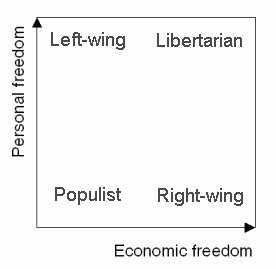
So now that I have concluded our political spectrum can not be analyzed by a line then what other model can we think of to explain the differences in political groups. A good place to start is Political Spectrum. The first chart is Nolan Chart. I like this because it shows that Liberatarians strive for more economic and personal freedoms.


But this also places Fascist and Communist in the same lower left corner, so maybe too simplistic. But try the test anyway.

And now for something completely different...Take the test. This might be the best model but what do you think? This would be the best test if you only want to do one, but it is fairly long.
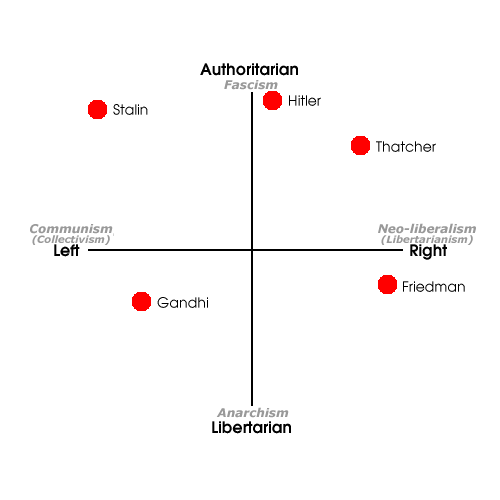
If we recognise that this is essentially an economic line it's fine, as far as it goes. We can show, for example, Stalin, Mao Tse Tung and Pol Pot, with their commitment to a totally controlled economy, on the hard left. Socialists like Mahatma Gandhi and Robert Mugabe would occupy a less extreme leftist position. Margaret Thatcher would be well over to the right, but further right still would be someone like that ultimate free marketeer, General Pinochet.
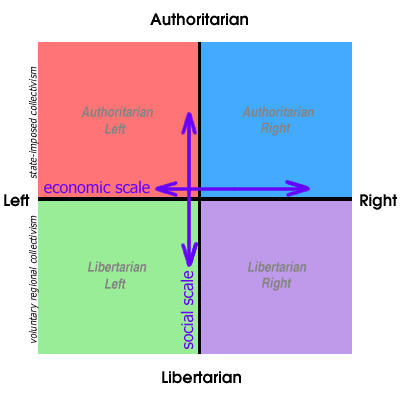
That deals with economics, but the social dimension is also important in politics. That's the one that the mere left-right scale doesn't adequately address. So we've added one, ranging in positions from extreme authoritarian to extreme libertarian.


Both an economic dimension and a social dimension are important factors for a proper political analysis. By adding the social dimension you can show that Stalin was an authoritarian leftist (ie the state is more important than the individual) and that Gandhi, believing in the supreme value of each individual, is a liberal leftist. While the former involves state-imposed arbitary collectivism in the extreme top left, on the extreme bottom left is voluntary collectivism at regional level, with no state involved. Hundreds of such anarchist communities exisited in Spain during the civil war period

You can also put Pinochet, who was prepared to sanction mass killing for the sake of the free market, on the far right as well as in a hardcore authoritarian position. On the non-socialist side you can distinguish someone like Milton Friedman, who is anti-state for fiscal rather than social reasons, from Hitler, who wanted to make the state stronger, even if he wiped out half of humanity in the process.

The chart also makes clear that, despite popular perceptions, the opposite of fascism is not communism but anarchism (ie liberal socialism), and that the opposite of communism ( i.e. an entirely state-planned economy) is neo-liberalism (i.e. extreme deregulated economy).

With some political points of views:

My results:
The Political Compass
Economic Left/Right: 7.38
Social Libertarian/Authoritarian: -0.56


Your political compass
Economic Left/Right: 7.38
Social Libertarian/Authoritarian: -1.74
{11/12/2010}


The next model is Pournelle. While I like the statism as a factor, defined as either "state as ultimate evil" and "state worship", and be sure to read this on rationalism also. All political groups want to portray themselves as not "irrational" but as "reason enthroned". Hank from here showed in the comments section that my ideas of rational thought is different than "rationalism". I think I will leave the pedantic philosophical discussions for others. I still question whether that factor in deciphering the political landscape is a significantly important.


The next model is Friesian Political Spectrum. It starts with the Nolan Chart and then makes it 3d with Z axis being liberty value. How about another test? I will try to study this later.


And lastly this chart is interesting. This seems to imply that we are more likely to get along with others in our group. But some international bonds are formed when both parties are willing to spend the social and political energy to get past cultural divides. Because I see the relationship of Japan and the US to be under this mutual cooperation, even though Japan is Confucian and the US is English Speaking.


I don't expect this to explain all aspects of political landscapes but at least get a primer started on thinking of how political parties in the US and the world should be analyzed in relationship to each other. One of my philosphies is that people or to a broader sense groups should be allowed to express themselves in their own words and not imposed by outside groups that want to disparage such groups in hyperbolic political attacks.

P.S.: I know that this might be going afield but Jason from ThomHartman's blog presented another political map defined as Triangle-of-Power. The three points of his equilateral triangle is defined as Government, Corporations and People. The Government is loosely defined as "The group that has control." This could mean elected politicians or a authoritarian monarchy like a king or a professional bureaucratic class. While Karl Marx does not put much emphasis on governments, he does talk about the bourgeoisie.
Corporations (bourgeoisie) as Jason defines is entities with wealth much greater than the average person. Marx: the bourgeoisie : those who "own the means of production" and exploit the proletariat. Jason does not define "wealth much greater than the average person", so we can not easily define who would be in that group. From his piece and his post on ThomHartman's blog, Jason sees corporations or businesses in general are a neccessary evil.
People (proletariat): This group is unique, as the other two are merely sub sections of this group. The People are all those that live on the land. Strangely enough, this group holds the most natural power when they act with one voice.

Thinking back to the triangle with the three corners being the categories of power, then you can see that where the country stands would be a combination of distances from the three corners. The closer the point is to one corner the more power that group has over the nation. I see that the lines are never possible to be at since each group has at least some power influence. But it is interesting to see the point with the three lines drawn to the respective corners.

Labels:

Monday, October 24, 2005

Political Left-Right and where are the Fascist?

One of the purposes of my blog is to explore and search out new ideas (at least to myself). Recently I seem to be seeing a lot of attention to "Fascism". At the above link sunny accused me of being a Fascist indirectly. Now in his defence I called him a communist (on this blog) and he has not responded. His links to Lenin's Tomb seems to explain it all. We should all honor a man that killed around 4 million of his own people. Not! Even if we are to claim 100,000 dealths then the US would need 100 years to kill 4 million. But since this has brought up some interesting intersections, I thought I would discuss "Fascism" and the left-right divide.

So first let me start with definitions:
1. A system of government marked by centralization of authority under a dictator, stringent socioeconomic controls, suppression of the opposition through terror and censorship, and typically a policy of belligerent nationalism and racism.
2. A political philosophy or movement based on or advocating such a system of government.

And:
n : a political theory advocating an authoritarian hierarchical government (as opposed to democracy or liberalism)


I believe in free markets with well defined property rights, decentralized government controls that follows all the principles of a liberal democracy and decry racism and belligerent nationalism. Well it sounds like I do not meet any of the Fascist principles. Let us look further into these issues.

Let me start with Dr. Rummels views in Hitler was a Socialist:
What is socialism? It is a politico-economic philosophy that believes government must direct all major economic decisions by command, and thus all the means of production for the greater good, however defined. There are three major divisions of socialism, all antagonistic to each other. One is democratic socialism, that places the emphasis on democratic means, but then government is a tool for improving welfare and equality. A second division is Marxist-Leninism, which based on a "scientific theory" of dialectical materialism, sees the necessity of a dictatorship ("of the proletariat") to create a classless society and universal equality. Then, there is the third division, or state socialism. This is non or anti-Marxist dictatorship that aims at near absolute economic control for the purpose of economic development and national power, all construed to benefit the people.

Mussolini's fascism was a state socialism that was explicitly anti-Marx and aggressively nationalistic. Hitler's National Socialism was state socialism at its worse. It not only shared the socialism of fascism, but was explicitly racist. In this it differs from the state socialism of Burma today, and that of some African and Arab dictatorships.

Also note that Nazi party never won popular support here:
Communists 4.8 million votes
Social Democrats 7.2 million votes
Centre party 5.5 million votes
Nationalists 3.1 million votes
Other parties 1.4 million votes
Nazis 17.3 million votes

And:
To be clear, National Socialism differs from Marxism in its nationalism, emphasis on folk history and culture, idolization of the leader, and its racism. But the Nazi and Marxist-Leninists shared a faith in government, an absolute ruler, totalitarian control over all significant economic and social matters for the good of the working man, concentration camps, and genocide/democide as an effective government policy (only in his last years did Stalin plan for his own Holocaust of the Jews).

Mein Kampf, Chapter 4:
If the National Socialist Movement should fail to understand the fundamental importance of this essential principle, if it should merely varnish the external appearance of the present State and adopt the majority principle, it would really do nothing more than compete with Marxism on its own ground. For that reason it would not have the right to call itself a philosophy of life. If the social programme of the movement consisted in eliminating personality and putting the multitude in its place, then National Socialism would be corrupted with the poison of Marxism, just as our national-bourgeois parties are.

This appears Socialist and leaning to Marxism. And from Gregor Strasser, a National Socialist theologian states:
We National Socialists are enemies, deadly enemies, of the present capitalist system with its exploitation of the economically weak ... and we are resolved under all circumstances to destroy this system.

Doesn't look like Socialist like the capatalist system. And:
There are two patterns for the realization of socialism. The first pattern (we may call it the Lenin or Russian pattern) . . . . the second pattern (we may call it the Hindenburg or German Pattern) nominally and seemingly preserves private ownership of the means of production and keeps the appearance of ordinary markets, prices, wages, and interest rates. There are, however, no longer entrepreneurs, but only shop managers ... bound to obey unconditionally the orders issued by government.

By Steve Kanga Myth:Hitler was a Leftist...
Many conservatives accuse Hitler of being a leftist, on the grounds that his party was named "National Socialist." But socialism requires worker ownership and control of the means of production. In Nazi Germany, private capitalist individuals owned the means of production, and they in turn were frequently controlled by the Nazi party and state. True socialism does not advocate such economic dictatorship -- it can only be democratic. Hitler's other political beliefs place him almost always on the far right. He advocated racism over racial tolerance, eugenics over freedom of reproduction, merit over equality, competition over cooperation, power politics and militarism over pacifism, dictatorship over democracy, capitalism over Marxism, realism over idealism, nationalism over internationalism, exclusiveness over inclusiveness, common sense over theory or science, pragmatism over principle, and even held friendly relations with the Church, even though he was an atheist.

We will get back to this later.

Let me see what Wikipedia has to say aboutFascism:
Fascism was typified by attempts to impose state control over all aspects of life. The definitional debates and arguments by academics over the nature of fascism, however, fill entire bookshelves. There are clearly elements of both left and right ideology in the development of Fascism.

Being a conservative, I do not believe in strong state control.

The US ,or world, political spectrum is represented as a simplistic line as in Left-Right Politics:
George Orwell once argued that the difficulty in classifying Left versus Right is due in part to the propensity for nascent factions of an ideology to be disavowed and labeled as being on the opposing side of the left-right divide by their erstwhile comrades - or they may so choose to label themselves to highlight their disagreement. This results in incremental or evolutionary doctrinal distinctions being placed in opposition in the popular perception of the left-right political spectrum.

My first political science instructor stated that the straight line was not sophisticated enough and he drew a circle with a small gap on the bottom. He said as politics went to the extreme left and right end up being closer to each other than the centrists. I believe that the closest were anarchists and communists.
For a start, Communism was never a social system at all, but a political MOVEMENT. There is a social system called ‘communism’, which literally means people living in communes (barracks), with no private ownership of property, no government, and everything shared out on the principle ‘from each according to their ability, to each according to their need’.

So now that I have concluded our political spectrum can not be analyzed by a line then what other model can we think of to explain the differences in political groups. A good place to start is Political Spectrum. The first chart is Nolan Chart. I like this because it shows that Liberatarians strive for more economic and personal freedoms. But this also places Fascist and Communist in the same lower left corner, so maybe too simplistic. But try the test anyway.

And now for something completely different...Take the test. This might be the best model but what do you think?

Next model is Pournelle. While I like the statism as an axis in "state as ultimate evil" and "state worship", but I see that Fascism and Naxisism as having rationalism also. All political groups want to portray themselves as not "irrational" but as "reason entroned".

The next model is Friesian Political Spectrum. It starts with the Nolan Chart and then makes it 3d with Z axis being liberty value. How about another test? I will try to study this later.

And lastly this chart is interesting. This seems to imply that we are more likely to get along with others in our group. But some international bonds are formed when both parties are willing to spend the social and political energy to get past cultural divides. Because I see the relationship of Japan and the US to be under this mutual cooperation, even though Japan is Confucian and the US is English Speaking.

I don't expect this to explain all aspects of fascism but at least get a primer started on thinking of how political parties in the US and the world should be analyzed in relationship to each other. One of my philosphies is that people or to a broader sense groups should be allowed to express themselves in their own words and not imposed by outside groups that want to disparage such groups in hyperbolic political attacks.

Links:
Progressivism is not dead! (But it's on life support ...)

Labels: